In January 2026, Cursor published a blog post on scaling long-running autonomous coding. Their first approach, flat coordination with agents sharing a single file, didn't work. Agents became cautious and focused on small, safe changes. There was a lot of activity, but not much progress.
The breakthrough came from hierarchy and specialization. First, a planner explores the codebase and decomposes it into tasks. Then a worker takes on a single task and grinds until it's done, ignoring everything else. Finally, a judge evaluates the result and decides whether to restart with fresh context or move on. The system ran for a week and wrote a million lines of code, creating a working web browser from scratch.
After that, they used the same system on an unpublished research-grade math problem in spectral graph theory. Four days later, it produced a solution that improved on the official proof created by humans, without hints or guidance. A coding harness solved a mathematics problem it was never meant to address.
As Nate B Jones pointed out, this isn't an isolated finding. By early 2026, four organizations — Anthropic, Google DeepMind, OpenAI, and Cursor — had built similar multi-agent coordination systems for long-term work, all independently. All four followed the same pattern: decompose the work, parallelize execution, verify outputs, iterate toward completion.
What they discovered are modes of organizational intelligence. Humans have always organized intelligence collectively in some fashion. The predominant forms of modern organization have done this through a complex vocabulary around particular models of intelligence and the ways they operate. We see this, for example, in the functional terms organizations use, like roles, handoffs, verification, and restart procedures. As Jones puts it, we figured out how to generalize our intelligence through collective work, and it turns out the same organizational structure scales to autonomous agents.
Syntroptic Design goes a step beyond that to develop operational modes of intelligence for regenerative organizations based upon living systems patterns and principles.
The missing layer
The AI industry currently operates on three layers: frameworks build agents, runtimes run them, and harnesses manage their lifecycle. The harness (the state management, context routing, tool access, and feedback loops around the model) is where most practical improvement lives. As the harness engineering community has demonstrated, agent reliability gains come primarily from the system surrounding the model rather than the model itself.
But the system extends beyond a single session, and that includes what the session is for, its purpose. Do the outputs serve the organization's purpose or just produce activity? For that you need a fourth layer: coordination architecture. The structured substrate of registries, schemas, and governance loops that agents orient to. Where the harness gives an agent state, coordination architecture gives it a context that already exists, shaped by the organization's values, not just its data.
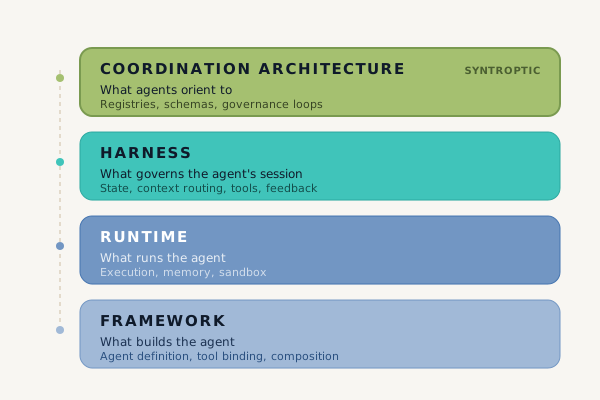
This is the layer the convergent architecture hints at without quite naming. Cursor's planner-worker-judge system works because the agents operate within a structured environment that persists across sessions. The judge can restart cleanly because the environment carries meaning forward. The coordination architecture is what makes the harness effective over time.
Why this matters beyond code
The convergent finding also revealed something about the nature of work itself. The relevant question isn't "can AI do this specific task?", it's "can this work be decomposed into verifiable sub-problems?" And it turns out the answer is yes far more often than most organizations have recognized.
Product strategy, legal research, campaign design, environmental program coordination. In each of these, experienced practitioners can evaluate whether the output is coherent. Efficient execution isn't enough. You need the ability to see whether things make sense. This means understanding if the work is cohesive and if it achieves its intended goal.
For mission-aligned organizations, this has particular weight. Coherence isn't just about productivity, it's about whether your operational systems reflect your values. An organization deploying AI agents without coordination architecture gets the efficiency but loses the alignment. The agents are productive. They're just not coherent with why the organization exists.
And the kind of coordination architecture that carries purpose plus state becomes more valuable with use. Structured environments compound across model generations. Prescribed workflows get obsoleted by them.
Four AI labs discovered this independently for code. The same structural insight applies wherever coordination is the bottleneck, which, increasingly, is everywhere.